
Solve et Coagula
Solve et coagula names the same process modern science calls biogeochemical cycling: the continual dissolving and recombining through which Earth stays alive. These are the processes utilized in the creation of spagyrics.
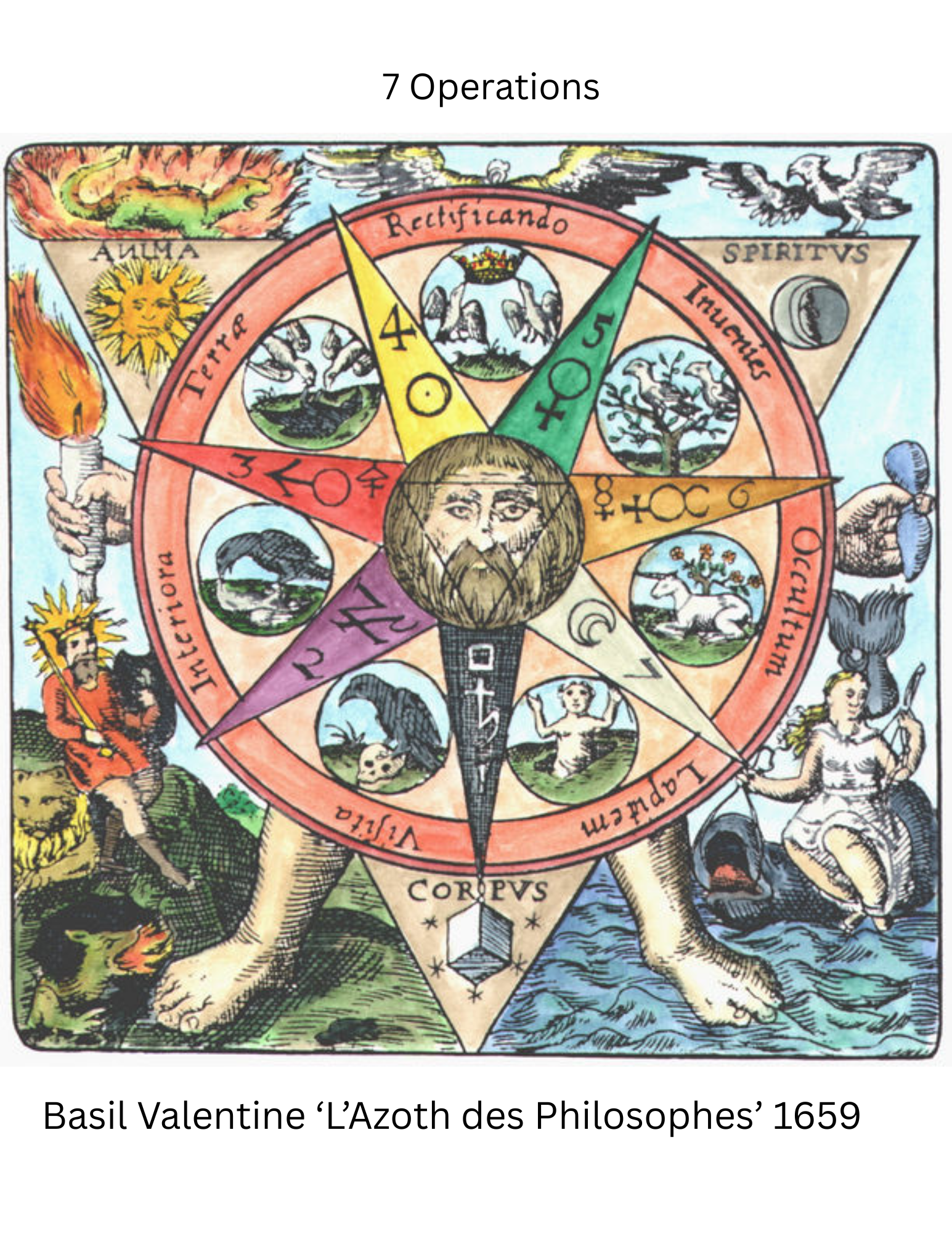
Alchemy is often misunderstood as a pursuit of power, an attempt to manipulate matter or bend nature to human will. But when I take a step back, that's how I see modern science’s approach to matter. As a dead material, to be manipulated for a function at the will of humans. At Alchemy’s foundation, it is a philosophy of nature, rooted in observation, humility, and relationship.
One of alchemy’s most fundamental principles is Solve et Coagula. You can find these words etched into the walls of old laboratories in Prague, or in old texts attempting to describe the foundations of how our world operates. Its translation is to ‘dissolve and recombine’. This idea is frequently treated symbolically, or just to be used in the laboratory as a means of extraction. But there seems to be very little inquiry as to where this understanding came from in modern writings. If we embody being inquisitive and take a look at our surroundings, we see that it is deeply operative in the natural world.
Everything living is very cyclical and furthermore in direct relationship with other living systems and beings around it. For a long time our modern science, that was born from a reductionist and mechanistic perspective, adopted the outlook that life only existed in a thin smear in the biosphere and there was no interaction, or very little that took place. It was believed that life spontaneously adapted to a static, mostly dead environment and evolved as seen personally fit ‘survival of the fittest’. Now we understand, that could not be further from the truth. Nothing grows in isolation and nearly everything is in conversation and response to one another.
Competition exists in the natural world, yes. If you put two species together they will compete for resources, this is what Charles Darwin came to. But when we view life and our world at scale, collaboration dominates. Algae influence cloud formation. Wolves shape river systems. Whales influence the ecosystems of the oceans. Humans are composed of nearly equal parts microbial and human cells. Meaning that we are just as much something else as we are ourselves. We exist as hosts, symbionts, and participants in a vast ecological network that precede and outlast us. This should serve as a reminder that we shouldn’t be so quick to center ourselves as the main character.
In the 1960’s James Lovelock began to ask questions as to how the atmosphere of earth was sustained even over long periods of time despite our sun getting hotter over that same time period. The temperature regulation of our earth remains quite controlled. Why is this? This question led to the Gaia Theory (1970). It proposed that Earth functions as a self-regulating system, shaped by feedback systems between life, atmosphere, water, and geology. The theory was ridiculed for a time until eventually it was proven. The carbon, phosphorus, sulfur, and nitrogen systems are participating and sustaining our world. And as it would appear, photosynthesis has cascading effects over large swaths of land. It seems that life really does not merely adapt to a static environment, it is actively creating and maintaining it. The atmosphere is an extension of the biosphere, much as the mind is an extension of DNA as Dorion Sagan once said.
Looking at how life is ‘working’ microorganisms certainly play a central role in this regulation. Long before plants and animals evolved, microbes were transforming nitrogen, sulfur, and carbon in abundance. Perhaps the plants learned how to partake in these operations from witnessing the world around them as they came to be. These metabolic processes underpin atmospheric composition today.
Mars and Venus for example, which are largely devoid of life, contain atmospheres dominated by carbon dioxide, around 95%. Earth by contrast maintains extraordinarily low CO₂ levels, around 0.04%. This is largely due to the miracle that is photosynthesis. Plants, algae, and bacteria continually remove carbon dioxide from the air, converting it into solid structures such as limestone reefs, and shells. Or plants utilizing the carbon as food and releasing oxygen as a by-product.
This stability is not luck. It is participation, relationship, and regulation happening.
In alchemy, Solve et Coagula describes this same pattern: matter is dissolved, transformed, and reassembled. This is the way we move in the lab participating in alchemical medicine making methods. We see Solve et Coagula in the water cycle, where water evaporates, condenses, and returns as rain, unchanged in essence yet always transformed. Or even the atoms in our bodies, they have existed for billions of years. We borrow them briefly and return them again to the land, sea and atmosphere. Touched by our lives.
The nitrogen cycle mirrors this process precisely as well. Nitrogen gas, inert and inaccessible to most, is made usable through bacterial action breaking apart the tight triple-bonds. It is transformed, assimilated, transferred through food webs, and eventually returned to the atmosphere and soil. The same principles apply to carbon, sulfur, and phosphorus. The act of dissolving and recombinging.
These cycles are not linear, they are feedback systems.
In the laboratory, alchemists attempted to mirror these natural processes, creating feedback loops that reveal transformation in hopes to create transformation on a small scale to better understand life and consciousness. Nature was always the inspiration, and still remains the greatest teacher. This understanding gave way to medicine making and early pharmaceutical practices.
Alchemy at its core is not about domination, or manipulation. It is about participation. The invitation of the Great Work is not to control nature, but to remember our place within it so we may understand it more. Not separate, not superior, but embedded within the living consciousness of Earth itself. This is where the foundation of Solve et Coagula came from. From looking at our environment as teacher and kin.